| Dear friends and colleagues,
We’d like to take a moment to share with you a little bit about what we’ve been doing in the last few months. Now in our third year, we continue to design and offer ground-breaking programs and events that advance the mission growing out of our award-winning PBS documentary, Traces of the Trade: A Story from the Deep North. Through our programs, we engage people from all backgrounds in honest, productive dialogues about race, privilege, and the history of slavery, and inspire action around these issues. Now in our third year, we continue to design and offer ground-breaking programs and events that advance the mission growing out of our award-winning PBS documentary, Traces of the Trade: A Story from the Deep North. Through our programs, we engage people from all backgrounds in honest, productive dialogues about race, privilege, and the history of slavery, and inspire action around these issues.
 We’re excited to announce that on the 150th anniversary of the Civil War and emancipation, and the 50th anniversary of major civil rights landmarks, we’re launching a public initiative inviting all Americans to reflect on the unfinished business of slavery, the Civil War, and the civil rights era. Stayed tuned for details in the months ahead. We’re excited to announce that on the 150th anniversary of the Civil War and emancipation, and the 50th anniversary of major civil rights landmarks, we’re launching a public initiative inviting all Americans to reflect on the unfinished business of slavery, the Civil War, and the civil rights era. Stayed tuned for details in the months ahead.
Do you have feedback or a suggestion for us, such as an issue that you’d like to see us address in our programs or on our blog? Please e-mail us.
Here are a few highlights of our recent activities:
- We generated more than 80 presentations across the country in 2012, at schools, colleges, churches, historic sites, and non-profit organizations, impacting thousands with our message of racial justice and healing.
- We led a workshop, at the invitation of the state senate president, for members of the Connecticut General Assembly and their staff.
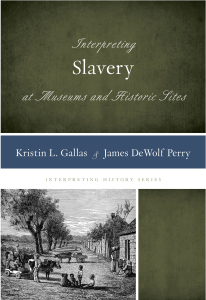
- We signed a contract and began research for a book, Interpreting Slavery, edited by Kristin Gallas and James Perry. The book will be published by Rowman & Littlefield and will offer analysis and case studies for the interpretation of slavery at museums and historic sites.
- We designed and conducted innovative workshops for history and social studies teachers and students in Georgia, Massachusetts, Virginia, and D.C., and presented programs at colleges and universities, including Harvard and Dartmouth.
- We began a collaboration to research and disseminate best practices for interpreting slavery at historic sites and museums. Our partners include the National Park Service, Smithsonian National Museum of African American History and Culture, Colonial Williamsburg, and Monticello.
- We participated in the 4th Traveling Caribbean Film Showcase, which brought the film and its message to Belize, Curacao, Angola, Antigua, the Bahamas, Barbuda, Brazil, the Cayman Islands, Saint Kitts and Nevis, and Martinique.
- We conducted professional training for graduate students at the UCLA Luskin School of Public Affairs, as part of our efforts to improve how those in the public sector address the black/white divide.
- We participated in the 77th Episcopal General Convention, sharing our work with several thousand attendees, and strengthened our relationships with the Evangelical Lutheran Church of America, the United Methodist Church, and Unitarian Universalist Association.
- We presented at national and regional conferences, including the American Association for State and Local History’s Annual Meeting, National Association for Interpretation’s 2012 National Workshop, New England Museum Association’s annual conference, Portsmouth Black Heritage Trail Annual Spring Symposium, 43rd Northeast Regional Conference on the Social Studies, and New England Black History Conference.
To keep up to date with our work, we encourage you to visit our blog and follow us on Facebook and Twitter. Also please feel free to forward this email to friends and family who might want to join our mailing list.
Thank you,
The Tracing Center team

|
|
|
|
|
Traces of the Trade
“Powerful is an inadequate word to describe the impact of Katrina Browne’s Traces of the Trade …. [This] clear-headed film represents an intense and searing call for national dialogue.”
– Kirk Honeycutt, Hollywood Reporter
 In Traces of the Trade: A Story from the Deep North, filmmaker Katrina Browne makes a troubling discovery – her New England ancestors were the largest slave-trading family in U.S. history. She and nine fellow descendants set out to retrace the “triangle trade,” from their Rhode Island hometown to slave forts in Ghana and plantation ruins in Cuba. Step by step, they uncover the extent of Northern complicity in slavery while stumbling through the minefield of contemporary race relations. Traces of the Trade offers powerful new perspectives on the black/white divide. |
Want to reach someone at the Tracing Center?
James DeW. Perry, Executive Director
Juanita C. Brown, Education Program Officer
Katrina C. Browne, Director of Ideas and External Affairs
Kristin L. Gallas, Director of Interpretation Projects
Marga Varea, Director of Events and Development
617-924-3400
Thank you to all the individuals who generously donated to our programs in the past year, and to our 2012 institutional funders, including the W.K. Kellogg Foundation and the Wyncote Foundation.
|
|
|
|
Feedback
“Next week, students will tackle a portion of American History we are sometimes hesitant to face head on. Slavery and the Slave Trade. We will be using an excellent documentary titled, Traces of the Trade. Every year I do a survey about my class and this week is one specifically mentioned by students as their favorites. I’m always impressed with the honest dialogue [the film] creates and the questions they ask.”
– Dave McIntire, The Independent School (Kansas)
“Last week’s workshop … ranks among one of the most meaningful I’ve ever attended and will have direct impact on the faculty I lead and the curriculum we teach.”
– Teacher workshop participant
“The movie and following discussions were one of the most interesting and meaningful presentations I’ve experienced in my 17 years at the school. I grew up in the south and experienced some of the most difficult times there in the 50’s and 60’s. I’ve always know firsthand about the effects of slavery in the south, but knew almost nothing of the history in the north.”
– Massachusetts teacher (department chair)
“It was an inspirational experience. You engaged us with the power and personal meaning of the account with the video and then made it human with your sensitive, intelligent, compassionate, and courageous dialogue. Your presentation was one of the most moving I have ever attended.”
– David Costello, Head of School, St. Peter’s School (Penns.)
Please share your feedback with us, too.
|
|
|



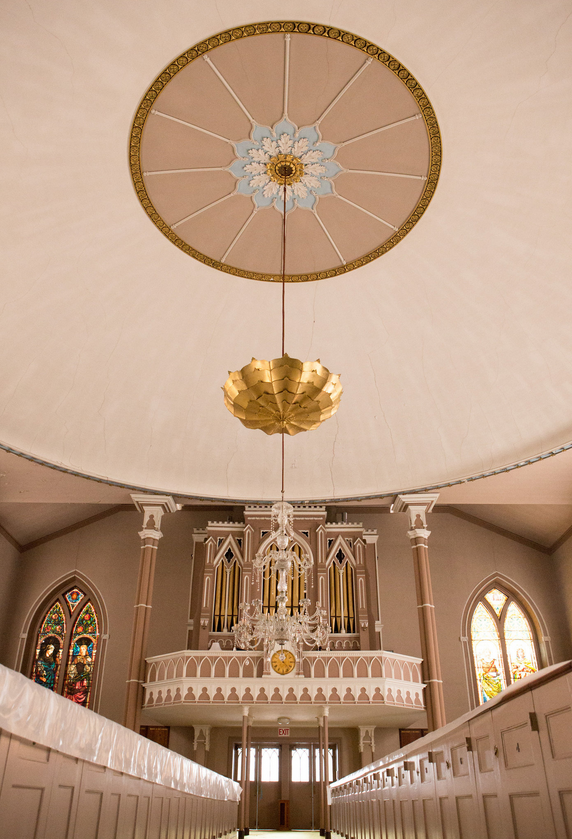 Today the New York Times is running an article on our partnership to create a Center for Reconciliation in the Episcopal cathedral in Providence, R.I.